Sonia DELAUNAY 1885-1979
-
 Sonia DELAUNAYProposal for the catalogue of the exhibition in Stockholm, 1916Wax on paper
 -
Sonia DELAUNAYRythme couleur, 1965Gouache and charcoal on paper
-
Sonia DELAUNAYRythme couleur, 1966Gouache, white and black chalk on paper
-
Sonia DELAUNAYRythme couleur, 1975Gouache and charcoal on paper


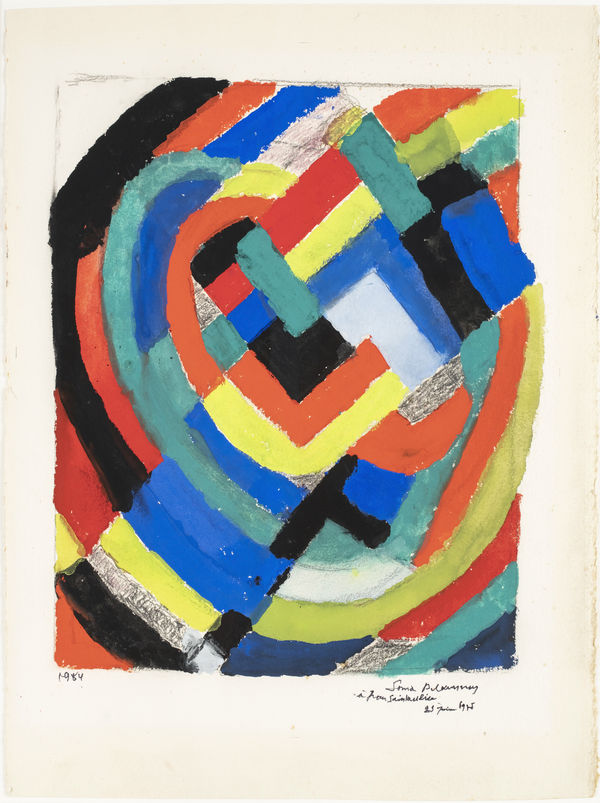


Sonia Delaunay was born in Russia and arrived in France in 1905. She married Robert Delaunay in 1910. Their union was enhanced by mutual inspiration and joint research on movement and colour. They were both particularly interested in Eugène Chevreul’s colour theory published in 1839 entitled ‘The Law of Simultaneous Colour Contrast’.
Sonia Delaunay: the strength of the color
Sonia Delaunay was born in Russia and arrived in France in 1905. She married Robert Delaunay in 1910. Their union was enhanced by mutual inspiration and joint research on movement and colour. They were both particularly interested in Eugène Chevreul’s colour theory published in 1839 entitled ‘The Law of Simultaneous Colour Contrast’.
Their painting set up a colourful structure that then became both the form and the subject of their work. They created a non-objective painting style that tried to express the rhythm of modern society and ended in 1912 with pure and abstract painting. Their paintings were then called Orphic Cubism by Guillaume Apollinaire that applied to works that celebrate life by focusing their research on the manifestations of light, seen as an original creator principle.
After the death of Robert Delaunay in 1941, she continued his experiments. She is the first woman to have had a retrospective at the Bing Gallery in 1953.
From 17 October 2014 to 22 February 201, the Musée d’Art Moderne de la Ville de Paris organized the first major Sonia Delaunay retrospective in Paris since 1967, with three remarkably recreated environments and over 400 works: paintings, wall decorations, gouaches, prints, fashion items and textiles.
This exhibition was shown at Tate Modern in London between 15 April and 9 August 2015. This was the first UK retrospective to assess the breadth of her vibrant artistic practice across a wide range of media.
A catalogue of 256 pages was also published by Paris Musées.